


Diagrams for 3D and 2D Motions 


In Cartoon Animator, a character's motions are divided into 3D and 2D motions. However, since this product is a 2D animation application, there is a certain workflow (different phases as described below) for converting 3D motions to 2D ones for better 2D editing.
*Please note that it is one-way direction between these phases, you can edit the motion back and forth within a certain phase but do not return to the previous phase for further editing.
 Phase 1: Converting iMotions to 3D Motions
For Pipeline users, you are able to import iClone iMotions into Cartoon Animator Character.
However, some initial refinements must be made to adjust visual flaws.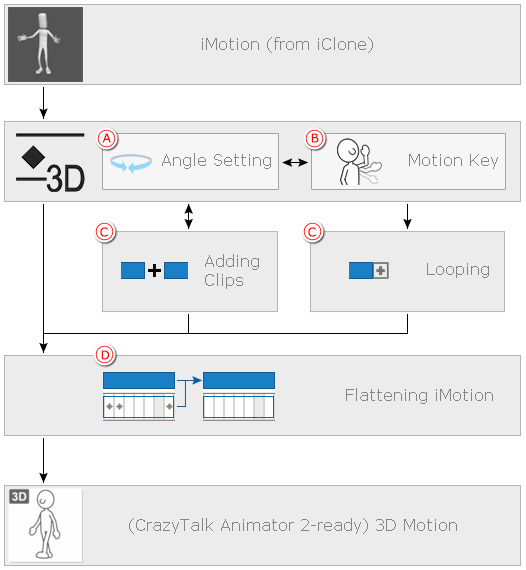
- Determine the initial angle for the entire iMotion.
- Using the 3D Motion Key Editor to eliminate visual flaws.
- Optionally loop or add more iMotions.
-
Flatten the iMotion or iMotions to merge the edit results in order to generate a
re-usable 3D motion.
Note:
Please refer to the Using iMotions section for more information.
Phase 2: Modifications for 3D Motions
You can apply 3D Motions to Cartoon Animator Character.
You are able to switch multiple angles in different time for the motion,
modify the motions by adding motion layer keys, using the layer order keys
for body parts, set time warp for clips, change the transition curve between
keys or clips and collect the entire motion data (clip and keys) as a 2D
motion for further 2D editing.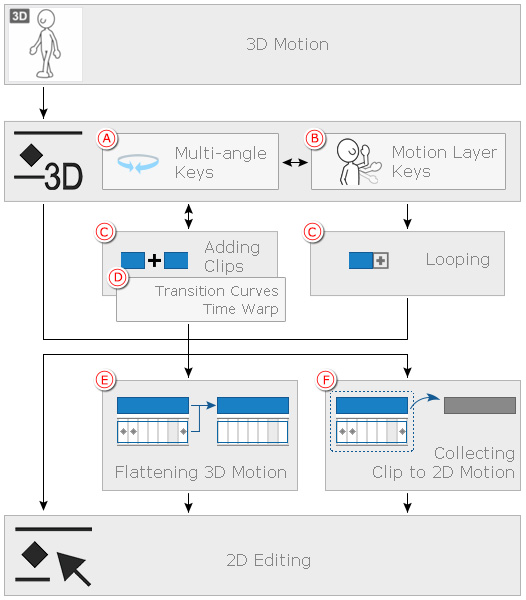
- Setting angle keys to turn the character to different angles during the 3D motion.
- Use the 3D Motion Key Editor to add motion layer keys to the original motion.
- Optionally loop or add more 3D motions.
- You can optionally adjust the transition curve type between two motions or change the time warp curve for individual motions.
- Flatten the 3D motion if you want to merge the modifications into the 3D motion.
-
Merge the entire data (3D motion and keys) into a 2D motion for 2D editing.
Note:
Please refer to the Using 3D Motions section for more information.
Phase 3: Polishing Motions with 2D Editing Skills
You can polish modified 3D motions or 2D motions by certain skills. The skills help you to
increase the interests and drama of the animations.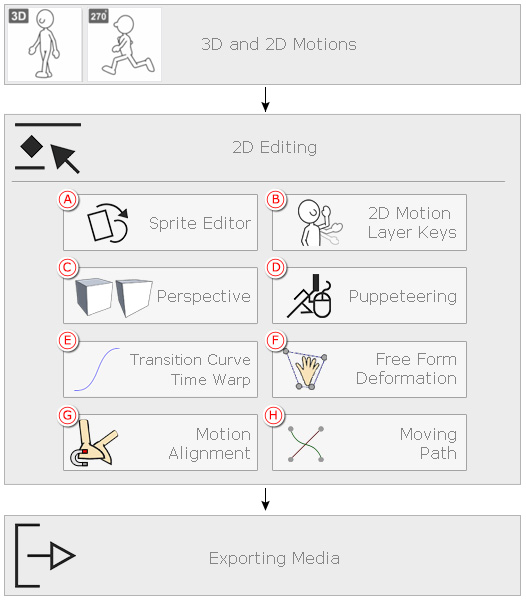
- Use the Sprite Editor to create sprite switching animations.
- Use the 2D Motion Key Editor to add motion layer keys to the original motion.
- To exaggerate the spatial and dimensional sensation of the character, set the Perspective Strength.
- Use the Puppeteering feature to create more custom 2D motions.
- The Transition Curve between two keys or clip or the Time Warp Curve for a specific motion can be adjusted.
- To distort the body parts for increasing interests, use the Free Form Deformation feature.
- Use the Motion Align feature to define a specific body part for aligning two motions.
-
You may define the character or prop to move in certain path and direction.
Note:
Please refer to the Using 2D Motions section for more information.
Principles of Animation
By mix-using the 2D-editing features provided by Cartoon Animator, you are able to create more interesting and attractive animations obeying the basic principles.
|
Animation Principles |
Descriptions |
Corresponding Feature(s) |
|
Timing |
The length of time for an animation to complete. |
|
|
Spacing |
The distance between two key poses. |
|
|
Squash and Stretch |
The compression and extension of an object during the animation. |
|
|
Anticipation |
The animation of an opposite direction prior to the main animation, which
prepare the viewer that the latter animation is the main action. |
|
|
Staging |
The explicit animation that makes no ambiguity, simply see and know what
the animation is, also known as body language. |
|
|
Pose to Pose |
Setting the key poses, add breakdowns and then add in-betweens. |
|
|
Drag, Follow Through and Overlapping Action |
The flexibility of an object's animations, comparing to the main
action. |
|
|
Slow In and Slow Out |
The length of time for an animation to complete. |
|
|
Arcs |
The path of the action; usually in smooth flow without abrupt changes of
directions. |
|
|
Secondary Action |
Some animations that is secondary to the main action. The
animations can be related or irrelevant to the main actions. |
|
|
Exaggeration |
Push the action even further than you think it shall be. |
|
|
Secondary Action |
Some animations that is secondary to the main action. The
animations can be related or irrelevant to the main actions. |
You may use the combinations of the listed features: |
|
Solid Drawing |
Solid drawing means a good drawing and a good drawing is mostly
determined by the poses of the character. Therefore, a solid
drawing is to give good poses for a character to convince the
viewer. |
|
|
Appeal |
A pleasing quality that makes the animation enjoyable to look at. |
|
|
Weight |
Make the animation feel heavy with proper weight. |
|
 or
or 


