Managing Full Body Animation
The full-body animation (iMotionPlus) is a combination of both facial (iTalk) and body (rlMotion) animations. After importing full-body animation assets in the .iMotionPlus tab, you can configure both facial and body animation settings to shape the motion.
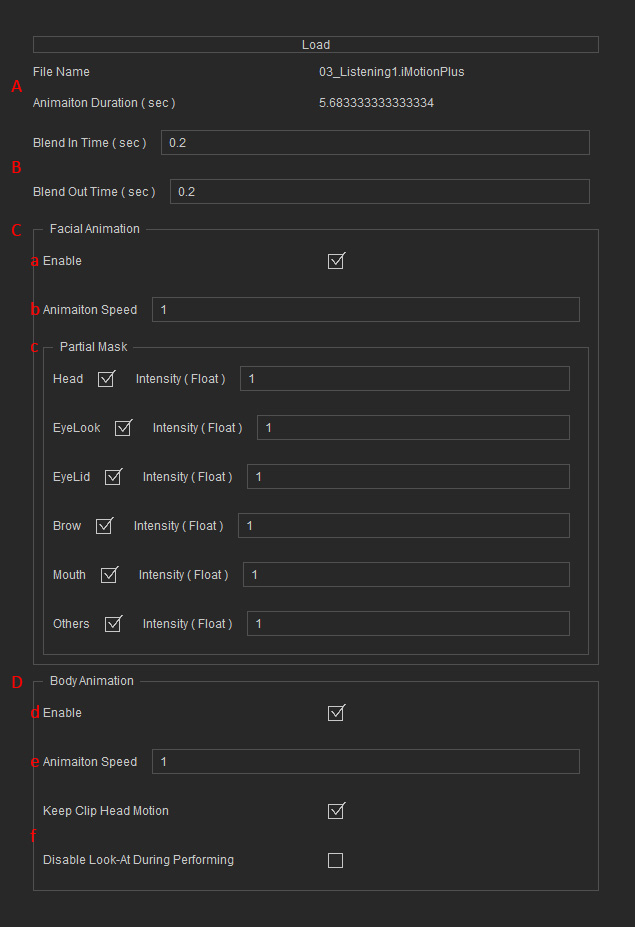
-
 File Info
- File Name: Displays the original filename of the imported animation.
- Animation Duration: Displays the total animation length in seconds.
-
Blending
Controls how the animation blends in from the previous action and blends out when it ends. These values need to be calibrated based on animation length and desired visual smoothness. You can set a numeric value (in seconds) with up to two decimal places for blending.
- Blend In Time: Defines the time taken to transition from the previous animation to the first frame of the new animation.
- Blend Out Time: Defines the time taken to transition from the last frame of the animation back to the original state.
-
Facial Animation Settings
-
Enable Facial Animation
Decides how the iMotionPlus animation will be played. It is checked by default to include facial animation (iTalk).
-
Animation Speed
Controls the playback speed of the animation in a float value with up to two decimal places. The value is 1 by default for normal speed. If the value is set to 2.0, the animation plays at 2× speed. If the value is set to 0.5, the animation slows down to 0.5× speed.
-
Partial Mask
Partial masking allows certain animation tracks to be hidden during playback, depending on the context. These options are enabled by default to enable facial expressions for all facial parts.
- Non-speaking State
- Head: Follows the procedural Head animation (Idle Profile) from the Idle Expression Graph.
- EyeLook: Follows the procedural Saccade animation (Idle Profile) from the Idle Expression Graph.
- EyeLid: Follows the procedural Brow animation (Idle Profile) from the Idle Expression Graph.
- Brow: Follows the procedural Brow animation (Idle Profile) from the Idle Expression Graph.
- Mouth: Follows the procedural Mouth animation (Idle Profile) from the Idle Expression Graph.
- Others: Enables the morphs other than the above facial parts in the facial animation (Cheek for example).
- Speaking State
- Head: Follows the driven Head animation (Speech Profile) from the Speech Graph.
- EyeLook: Follows the driven Saccade animation (Speech Profile) from the Speech Graph.
- EyeLid: Follows the driven Brow animation (Speech Profile) from the Speech Graph.
- Brow: Follows the driven Brow animation (Speech Profile) from the Speech Graph.
- Mouth: All mouth animations are automatically enabled and replaced by NVidia ACE A2F Lip Sync, which translates speech into ARKit facial animations.
- Others: Enables the morphs other than the above facial parts in the facial animation (Cheek for example).
- Intensity: Controls the intensity percentage of each facial part with a float value of up to two decimal place precision.
- Non-speaking State
-
-
Body Animation Settings
-
Enable Body Animation
Decides how the iMotionPlus animation will be played. It is enabled by default to include body animation (rlMotion).
-
Animation Speed
Controls the playback speed of the animation with a float value up to two decimal place precision. The value is 1 by default for normal speed. If the value is set to 2.0, the animation plays at 2x speed. If the value is set to 0.5, the animation slows down by half.
-
Animation Mask
There are two types of masking behaviors for body animation.
- Keep Head Clip Motion
- Enabled: Uses the animation's own head movements.
- Disable: Applies the head behavior from the last executed Auto Profile.
- Disable Look-At During Performing
- Enabled: The eyes follow the animation's own behavior during playback. If the animation lacks eye movement data, it will apply the last executed Auto Profile settings.
- Disabled: The eyes remain locked onto the last targeted camera during playback.
- Keep Head Clip Motion
-
